Urban planner Nick Falbo wants more people to ride bicycles and came up with a simple yet amazing idea of “protected intersections” for the George Mason University 2014 Outside the Box Competition. Take a look and you’ll see what he means…
Month: April 2014
My Plus One reinvents the way to travel: It’s all about the locals!
Taking a weekend city trip is a great experience, but somehow it always seems like the locals are having all the fun. You, as the stranger on the other hand, all too often miss out on so many things. If you’ve visited Berlin, Germany, and wished you knew where to find the best entertainment or the “in” places to eat, most of the time you don’t have any other choice rather than checking what your travel guide suggests. Travel guides – designed to meet the interests of the greatest possible group of people by neglecting any type of individuality. The problem to be solved here is obvious, isn’t it?
“The local experience” is what everyone hopes for when taking a trip to a foreign city. Clare Freeman, world traveller and entrepreneur, provides just that. The concept of her startup My Plus One is simple: “Most of us travel these days and often know people abroad. But if you’re going somewhere you don’t know, perhaps for business or just an adventure, it’s easy to waste time seeing the wrong places, getting lost or ending up in tourist traps”, she explains on her website. Clare has launched the city break with a difference – you not only have a choice of selected hand-picked accommodations, you also get the company of a local resident who can show you where it’s all happening.

My Plus One has a selection of local guides who are chosen for their knowledge and passion of the city. When a guest makes their reservation, they choose what they wish to experience. There are many options to choose from, ranging from a coffee hangout with a local, just to get their tips and recommendations, up to a long booking when you go out with them. The costs differ (20-40€) but payment method doesn’t always have to be monetary: You may also choose to pay in the form of a gift or skill-share up to the value of the booking. For example, you could offer your Plus One an item of clothing, a bottle of wine, or perhaps a lesson in juggling! In short: it’s all a matter of negotiation between you and your local.
My Plus One launched in Berlin in March 2012 with 15 friends and one studio. Since then, the community has grown to nearly 100 locals and 14 accommodation partners across 5 cities (Berlin, London, Paris, Amsterdam and Barcelona). By now Claire has gathered a small team in Berlin, passionate about making travel more enjoyable, beneficial and interesting for all of us. What a great example of changing the way we travel by thinking outside the box. So before booking your next weekend city trip make sure to make this one a true local experience.
Picture: © http://www.myplusone.net
Wundercar takes car-sharing in Germany to the next level
Have you ever wished for a taxi-like experience, but without the cost and depressing atmosphere of an actual taxi ride? Wundercar might have found the answer to that wish and started with an App last month in Hamburg and Berlin. The Hamburg-based startup founded by Gunnar Froh (former Airbnb) describes itself as a ride-sharing service offering more than just a simple ride from A to B but an urban experience with local drivers. The corresponding slogan: Catch a ride – Create a story.
For those of you not familiar with the ride-sharing economy, ideas like Wundercar’s aren’t exactly new – examples like Lyft or Sidecar are two relatively well-known services that are already operating in the US. However, in Europe there seems to be a lack of short-ride sharing hops. There are short time rental services like Car2Go and DriveNow, or companies like BlaBlaCar and Mitfahrgelegenheit for longer journeys but nothing yet that really offers an on-demand service.

The Wundercar model is pretty simple. All rides are on-demand and free by default. If the passenger thinks the driver and journey were worth paying for, they give a donation. The corresponding App suggests a certain donation (based on what other passengers donated for the same distance) and Wundercar will take a 20 percent cut. That way, Wundercar bypasses all the recent turmoils about regulatory issues in the car-sharing economy in Germany.
And for those that simply never pay for their rides, there is a feedback system for passengers and drivers. Too many bad reviews and there’s a good chance that people will simply stop picking you up. The same goes for drivers: only Wundercar pre-certified drivers with primarily positive feedback are allowed into the community. “At the end of the ride it’s up to the guest if they want to make a donation to the driver. The basic assumption is that you ride for free, but if you liked it you can make a donation through the app, but you have to keep in mind that the driver will rate the guest at the end”, Froh told TNW.
While Wundercar is launching its service first in Berlin and Hamburg, the Company is already targeting other German locations as well as international cities like London – a metropolis with virtually no viable alternative to incredibly expensive cab rides for short hops across town. The climate for expansion seems favorable, as Wundercar has secured a seven-digit seed funding amount in late 2013 and with no other competition in Europe in sight.
Froh’s experience at Airbnb will help the Company to fight against upcoming regulatory hurdles that may arise in the future. “With Airbnb, I spent a good part of my time meeting with city representatives in Hamburg, Berlin and other cities…making proposals for how to adapt local regulations, and we’re now again doing that in this context” he said in an interview with TNW. Having managed to become a viable, safe alternative to unnecessarily expensive cab rides in Berlin and Hamburg already represents quite an achievement for a company that has been founded only in fall 2013. I truly hope that they can pull off to bring their model to other cities as well – Car sharing 2.0 at its best.
Picture: © Wundercar.org
EPIC Companies comes out strong in first year
It was almost exactly one year ago, that ProSiebenSat.1 unveiled its new company builder EPIC Companies. Since then, the incubator has managed to become an integral part of the German startup scene. EPIC has been a busy bee during its first year and is regularly one of the hottest discussion topics in the scene. The portfolio of EPIC currently comprises of six startups, being: Amorelie, Discavo, Gymondo, Petobel, TodayTickets and Valmano.
The Online jewelry shop Valmano (2013), the food shopping platform Petobel (2013) and the Online hotel search Discavo (2014) have been founded and brought up by the Company itself. “Homemade Start-up” is the inhouse term being used at EPIC. The Online fitness platform Gymondo has been acquired during summer 2013 and since then been equipped with a new executive team including a relaunch in early 2014. Amorelie, the online sex shop, is part of the EPIC family since January 2014, when EPIC invested a six-figure amount in the startup (comprising of cash and media coverage benefits). Besides, EPIC is one of the main investors in the Ticket-App TodayTickets, which was founded in 2013.
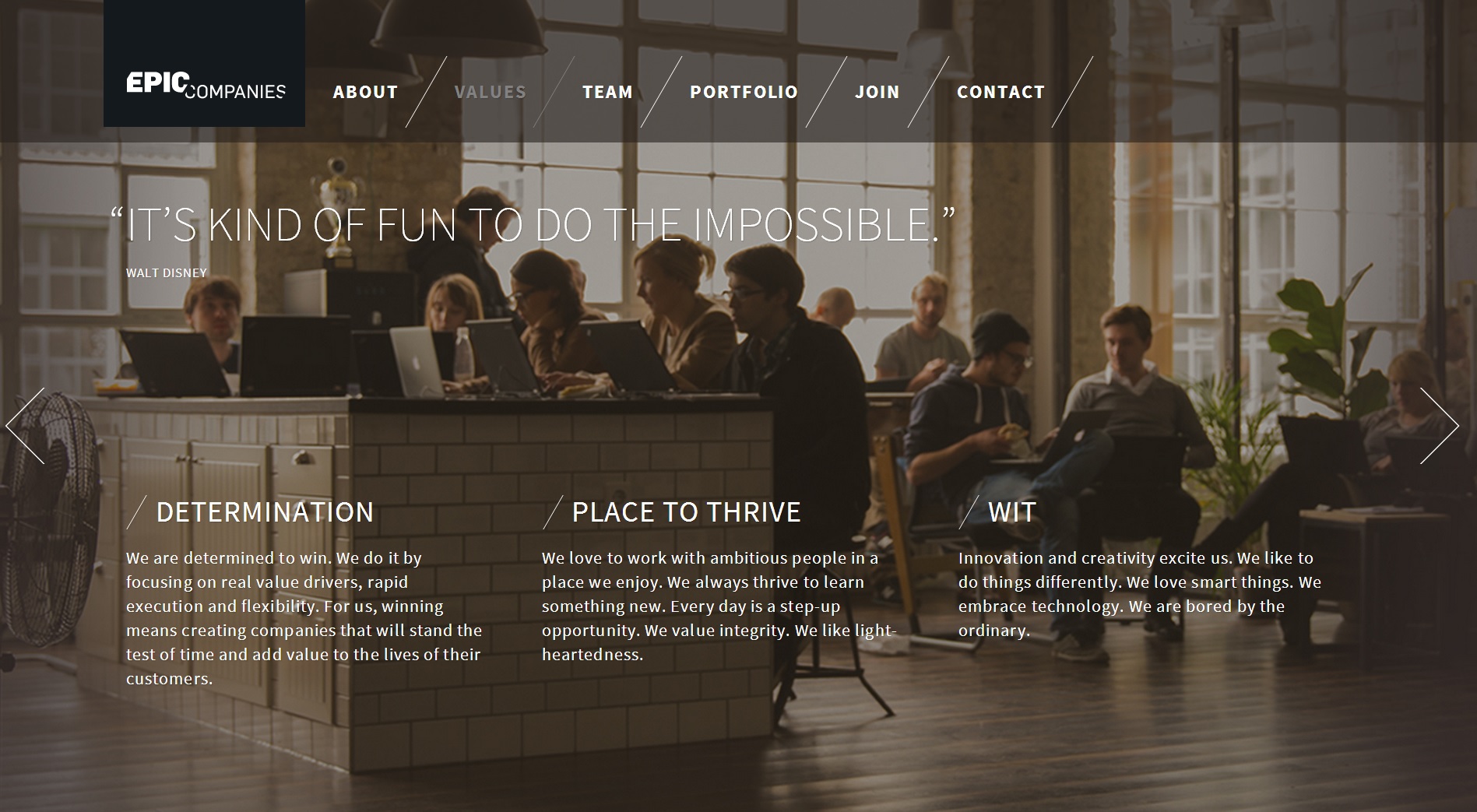
EPICs first year investments show a distinct and clear tendency towards the E-commerce segment. The incubator provides mainly early stage money, entrepreneur-expertise and media benefits through its parent company ProSiebenSat.1. Especially the media cooperation plays a decisive role for EPIC startups as they have the opportunity to advertise themselves through the TV-channels of the media group. The incubator sees the media presence especially for early stage startups as a crucial USP and a competitive advantage towards other startups. While the TV-presence is a useful tool that not many early stage startups can afford, it is no guarantee for success.
EPIC’s goal to launch four to five promising startups per year seems ambitious, yet feasible, given the companies expertise and management team around Mato Peric (former Rocket Internet). The Company, which settled in a hip building in Berlin-Kreuzberg’s Paul-Lincke-Ufer, formerly inhabited by German rapper Sido, is growing rapidly and meanwhile employs over 250 people (including portfolio companies). “The next three platforms are already in the works and will be launched in the next few weeks” announces Peric. It looks like EPIC is positioning itself for a bright future as one of the most recognized German company builders.
Picture: © EPIC companies
Recycling platform for failed startups Rehype goes live

9 out of 10 startups fail. This simple rule is ubiquitous and is keeping many entrepreneurs from even trying their luck. Rehype.it is a new platform that aims to capitalize on that fact. The project, which started earlier this month, provides failed startups with a second chance. Participants can sell brands, domains or a complete businesses through the marketplace. The website sardonically states: “Your startup is insolvent – so what? With Rehype.it you can now turn every part of your project into cash.”
Tom Schneider, founder of Rehype explains the idea behind his startup: “Our concern is that, what has been created in many projects is not simply buried and thrown away, but that other people might be able to do something with it. People who may have better contacts or financial resources or an idea to take things a little differently.” He also points out that Rehype “is not just about failed start-ups, but also about projects that are already advanced, but cannot be continued for some reason.”
So if you are looking to get your hands on a few ideas (failed for whatever reason) or just want to be inspired by projects of other people, Rehype might be the place to check out. The market place grants its users an early bird special that includes free membership for the first 90 days after its inauguration. I’m already signed up. How about you?
Picture: © Rehype.it
Back to the roots for startups: Good ol’ fashioned German engineering know-how

Whenever there is talk of a innovative ideas these days, people almost inevitably tend to think of a groundbreaking app or software that is being developed by tech experts from the Valley or Berlin. Not this time though. Bragi, a hardware-centered startup based in Munich, is drawing fresh attention to the promise of good ol’ fashioned German engineering know-how through their most recent innovation.
You’ve heard of smartphones, smartwatches, and maybe even smartpants, but the German startup Bragi has just used Kickstarter to gather steam for an entirely new concept: smart headphones. The so-called Dash headphones raised over USD 3.3million, therefore exceeding the original goal USD 260,000 by 1,300%. So the question comes to mind: What makes the Dash headphones so special?

Well, first off not only do they offer the usual slate of advanced features like Bluetooth wireless connectivity and a built-in mic, they perform all sorts of functions that have nothing to do with audio. As visualized in the image above, the Dash has three main functions: Listen, Track, Communicate.
Listen
Even if you have no interest in using the Dash for their athlete-focused properties, the smart headphones offer up even more impressive features. For instance, the headphones offer passive noise isolation to say, let you sleep on a plane, but you can also turn on “audio transparency” to pass through ambient noise when you need it, like riding a bike. The Dash are completely water-resistant (the video shows a surfer using the ‘phones) and an embedded 4GB music player can hold roughly 1,000 songs to play when you don’t have a phone connected.
Track
The Dash tracks the body’s performance during exercise, monitoring speed, time, distance and cadence, as well as heart rate, oxygen saturation and energy spent. All of these statistics are monitored in real-time while acoustic feedback is provided in the background. For instance, a demo video for the Dash shows a skier hearing his heart rate, speed, drop rate, pulse and pace during a run. Apparently the headphones achieve this with some very delicate little tools: a 3-axis accelerometer, infrared LED and optical sensor, a five-field capacitive sensor, and even a 32-bit ARM processor like you might find in a smartphone. It even works without an attached smartphone.
Communicate
In addition to being earphones, the Dash can also double as a Bluetooth Headset delivering clear voice quality through the embedded ear bone microphone. A swipe on the capacitive touch surface will enable or disable ambient sound to pass through. The Dash has an ambient microphone in the left and right ear phone. It records, when needed, a wide frequency range, from engine noise to birds singing and also promises to be able to translate foreign languages in real time.
According to rankings on Kickstarter, the campaign is the largest donation-based funding drive by a European start-up to date —a milestone for the German tech scene. The Dash headphones can be pre-ordered for USD 299 over the offical website. I don’t know about you but I’ve been waiting for a product like this for a very long time. Sleek German engineering paired with multinational design and usability sound pretty promising – the price however, not so much.
Pictures: © bragi.com
Takeaway.com acquires German food delivery services Lieferando

Food delivery services have been booming for the past couple of years, and many players are trying their luck in what is becoming a quite crowded market in Germany. With the most recent acquisition Takeaway.com, an originally Dutch company active in Germany with daughter Lieferservice.de, has bought its competitor Lieferando. Takeaway is planning on merging the two brands, which brand will disappear however, remains to be seen. “Lieferando is an extraordinary successful business with the best product in the market. Together our goal is not only to become the market leader in Germany and Poland, but to build up the biggest online food ordering platform worldwide”, says Takeaway-founder Jitse Groen.
A consolidation has been rumored by industry experts over the past few months as the market for online food delivery is getting more and more dense. The high number of competitors was inevitably leading to acquisition proposals. The German press has been speculating that Lieferando shareholders will have fetched a price of over EUR 50million from Takeaway. Delivery Hero, who was also said to be in the race for Lieferando, apparently backed out of the deal unwilling to pay a price of this dimensions.
In the course of the completion of the deal, existing investors Prime Ventures and Macquarie Capital, the investment arm of the Australian investment bank renowned for its infrastructure investments, without hesitation injected another EUR 74million into the newly consolidated business. The investment is supposed to provide enough leeway to become #1 in the Germany online food delivery market.
Lieferando was founded in 2009 by Christoph Gerber, Jörg Gerbig and Kai Hansen and was backed by early-stage incubator Rheingau Ventures. In the past years, the company has raised more than EUR 20million from investors like DuMont Venture, Macquarie and the KfW and attracted media attention through massive tv-advertising. Lieferando’s management team will be given senior executive positions in Takeaway.com. That’s the way to merge two profitable and fast-growing companies and keeping everybody happy. At least for now…
How does an early-stage investor value a startup?
The following is a great piece by Carlos Eduardo Espinal, co-manager at Seedcamp.com, about startup valuation methods that I did not want to keep from you. Enjoy the exciting read.
– One of the most frequently asked questions at any startup event or investor panel, is “how do investors value a startup?”. The unfortunate answer to the question is: it depends.
Startup valuation, as frustrating as this may be for anyone looking for a definitive answer, is, in fact, a relative science, and not an exact one.
For those of you that want to cut to the summary of this post (which is somewhat self-evident when you read it) here it is:
The biggest determinant of your startup’s value are the market forces of the industry & sector in which it plays, which include the balance (or imbalance) between demand and supply of money, the recency and size of recent exits, the willingness for an investor to pay a premium to get into a deal, and the level of desperation of the entrepreneur looking for money.
Whilst this statement may capture the bulk of how most early stage startups are valued, I appreciate that it lacks the specificity the reader would like to hear, and thus I will try and explore the details of valuation methods in the remainder of this post with the hopes of shedding some light on how you can try and value your startup.
As any newly minted MBA will tell you, there are many valuation tools & methods out there. They range in purpose for anything from the smallest of firms, all the way to large public companies, and they vary in the amount of assumptions you need to make about a company’s future relative to its past performance in order to get a ‘meaningful’ value for the company. For example, older and public companies are ‘easier’ to value, because there is historical data about them to ‘extrapolate’ their performance into the future. So knowing which ones are the best to use and for what circumstances (and their pitfalls) is just as important as knowing how to use them in the first place.
Some of the valuation methods you may have have heard about include:
- The DCF (Discounted Cash Flow)
- The First Chicago method
- Market & Transaction Comparables
- Asset-Based Valuations such as the Book Value or the Liquidation value
While going into the details of how these methods work is outside of the scope of this post, I’ve added some links that hopefully explain what they are. Rather, let’s start tackling the issue of valuation by investigating what an investor is looking for when valuing a company, and then see which methods provide the best proxy for current value when they make their choices.
A startup company’s value, as I mentioned earlier, is largely dictated by the market forces in the industry in which it operates. Specifically, the current value is dictated by the market forces in play TODAY and TODAY’S perception of what the future will bring.
Effectively this means, on the downside, that if your company is operating in a space where the market for your industry is depressed and the outlook for the future isn’t any good either (regardless of what you are doing), then clearly what an investor is willing to pay for the company’s equity is going to be substantially reduced in spite of whatever successes the company is currently having (or will have) UNLESS the investor is either privy to information about a potential market shift in the future, or is just willing to take the risk that the company will be able to shift the market. I will explore the latter point on what can influence you attaining a better (or worse) valuation in greater detail later. Obviously if your company is in a hot market, the inverse will be the case.
Therefore, when an early stage investor is trying to determine whether to make an investment in a company (and as a result what the appropriate valuation should be), what he basically does is gauge what the likely exit size will be for a company of your type and within the industry in which it plays, and then judges how much equity his fund should have in the company to reach his return on investment goal, relative to the amount of money he put into the company throughout the company’s lifetime.
This may sound quite hard to do, when you don’t know how long it will take the company to exit, how many rounds of cash it will need, and how much equity the founders will let you have in order to meet your goals. However, through the variety of deals that investors hear about and see in seed, series A and onwards, they have a mental picture of what constitutes and ‘average’ size round, and ‘average’ price, and the ‘average’ amount of money your company will do relative to other in the space in which it plays. Effectively, VCs, in addition to having a pulse of what is going on in the market, have financial models which, like any other financial analyst trying to predict the future within the context of a portfolio, have margins of error but also assumptions of what will likely happen to any company they are considering for investment. Based on these assumptions, investors will decide how much equity they effectively need now, knowing that they may have to invest along the way (if they can) so that when your company reaches its point of most likely going to an exit, they will hit their return on investment goal. If they can’t make the numbers work for an investment either relative to what a founder is asking for, or relative to what the markets are telling them via their assumptions, then an investor will either pass, or wait around to see what happens (if they can).
So, the next logical question is, how does an investor size the ‘likely’ maximum value (at exit) of my company in order to do their calculations?
Well, there are several methods, but mainly “instinctual” ones and quantitative ones. The instinctual ones are used more in the early-stage type of deals and as the maturity of the company grows, along with its financial information, quantitative methods are increasingly used. Instinctual ones are not entirely devoid of quantitative analysis, however, it is just that this “method” of valuation is driven mostly by an investor’s sector experience about what the average type of deal is priced at both at entry (when they invest) and at exit. The quantitative methods are not that different, but incorporate more figures (some from the valuation methods outlined) to extrapolate a series of potential exit scenarios for your company. For these types of calculations, the market and transaction comparables method is the favored approach. As I mentioned, it isn’t the intent of this post to show how to do these, but, in summary, comparables tell an investor how other companies in the market are being valued on some basis (be it as a multiple of Revenues or EBITDA, for example, but can be other things like user base, etc) which in turn can be applied to your company as a proxy for your value today. If you want to see what a professionally prepared comps table looks like (totally unrelated sector, but same idea), go here.
Going back to the valuation toolset for one moment… most of the tools on the list I’ve mentioned include a market influence factor , meaning they have a part of the calculation that is determined by how the market(s) are doing, be it the market/industry your company operates in, or the larger S&P 500 stock index (as a proxy of a large pool of companies). This makes it hard, for example to use tools (such as the DCF) that try and use the past performance of a startup (particularly when there is hardly a track record that is highly reliable as an indicator of future performance) as a means by which to extrapolate future performance. This is why comparables, particularly transaction comparables are favored for early stage startups as they are better indicators of what the market is willing to pay for the startups ‘most like’ the one an investor is considering.
But by knowing (within some degree of instinctual or calculated certainty) what the likely exit value of my company will be in the future, how does an investor then decide what my value should be now?
Again, knowing what the exit price will be, or having an idea of what it will be, means that an investor can calculate what their returns will be on any valuation relative to the amount of money they put in, or alternatively what their percentage will be in an exit (money they put in, divided by the post-money valuation of your company = their percentage). Before we proceed, just a quick glossary:
Pre-Money = the value of your company now
Post-Money = the value of your company after the investor put the money in
Cash on Cash Multiple = the multiple of money returned to an investor on exit divided by the amount they put in throughout the lifetime of the company
So, if an investor knows how much % they own after they put their money in, and they can guess the exit value of your company, they can divide the latter from the former and get a cash-on-cash multiple of what their investment will give them (some investors use IRR values as well of course, but most investors tend to think in terms of cash-on-cash returns because of the nature of how VC funds work). Assume a 10x multiple for cash-on-cash returns is what every investor wants from an early stage venture deal, but of course reality is more complex as different levels of risk (investors are happy with lower returns on lower risk and later stage deals, for example) will have different returns on expectations, but let’s use 10x as an example however, because it is easy, and because I have ten fingers. However, this is still incomplete, because investors know that it is a rare case where they put money in and there is no requirement for a follow-on investment. As such, investors need to incorporate assumptions about how much more money your company will require, and thus how much dilution they will (as well as you) take provided they do (or don’t ) follow their money up to a point (not every investor can follow-on in every round until the very end, as many times they reach a maximum amount of money invested in one company as is allowed by the structure of their fund).
Now, armed with assumptions about the value of your company at exit, how much money it may require along the way, and what the founding team (and their current investors) may be willing to accept in terms of dilution, they will determine a ‘range’ of acceptable valuations that will allow them, to some extent, to meet their returns expectations (or not, in which case they will pass on the investment for ‘economics’ reasons). This method is what I call the ‘top-down’ approach…
Naturally, if there is a ‘top-down’, there must be a ‘bottom-up’ approach, which although is based on the ‘top-down’ assumptions, basically just takes the average entry valuation for companies of a certain type and stage an investor typically sees and values a company relative to that entry average. The reason why I say this is based on the ‘top-down’ is because that entry average used by the bottom-up approach, if you back-track the calculations, is based on a figure that will likely give investors a meaningful return on an exit for the industry in question. Additionally, you wouldn’t, for example, use the bottom-up average from one industry for another as the results would end up being different. This bottom-up approach could yield an investor saying the following to you when offering you a termsheet:
“a company of your stage will probably require x millions to grow for the next 18 months, and therefore based on your current stage, you are worth (money to be raised divided by % ownership the investor wants – money to be raised) the following pre-money”.
One topic that I’m also skipping as part of this discussion, largely because it is a post of its own, is “how much money should I raise?”. I will only say that you will likely have a discussion with your potential investor on this amount when you discuss your business plan or financial model, and if you both agree on it, it will be part of the determinant of your valuation. Clearly a business where an investor agrees that 10m is needed and is willing to put it down right now, is one that has been de-risked to some point and thus will have a valuation that reflects that.
So being that we’ve now established how much the market and industry in which you company plays in can dictate the ultimate value of your company, lets look at what other factors can contribute to an investor asking for a discount in value or an investor being willing to pay a premium over the average entry price for your company’s stage and sector. In summary:
An investor is willing to pay more for your company if:
- It is in a hot sector:investors that come late into a sector may also be willing to pay more as one sees in public stock markets of later entrants into a hot stock.
- If your management team is shit hot: serial entrepreneurs can command a better valuation. A good team gives investors faith that you can execute.
- You have a functioning product (more for early stage companies)
- You have traction: nothing shows value like customers telling the investor you have value.
An investor is less likely to pay a premium over the average for your company (or may even pass on the investment) if:
- It is in a sector that has shown poor performance.
- It is in a sector that is highly commoditized, with little margins to be made.
- It is in a sector that has a large set of competitors and with little differentiation between them (picking a winner is hard in this case).
- Your management team has no track record and/or may be missing key people for you to execute the plan (and you have no one lined up). Take a look at a post on ‘do I need a technical founder?‘.
- Your product is not working and/or you have no customer validation.
- You are going to shortly run out of cash
In conclusion, market forces right now greatly affect the value of your company. These market forces are both what similar deals are being priced at (bottom-up) and the amounts of recent exits (top-down) which can affect the value of a company in your specific sector. The best thing you can do to arm yourself with a feeling of what values are in the market before you speak to an investor is by speaking to other startups like yours (effectively making your own mental comparables table) that have raised money and see if they’ll share with you what they were valued and how much they raised when they were at your stage. Also, read the tech news as sometimes they’ll print information which can help you back track into the values. However, all is not lost. As I mentioned, there are factors you can influence to increase the value of your startup, and nothing increases your company’s value more than showing an investor that people out there want your product and are even willing to pay for it.
Other pieces on the subject
Google follows Facebook by acquiring the auspicious drone startup Titan
 Google has acquired Titan Aerospace, the drone startup that makes high-flying robots which was previously scoped by Facebook as a potential acquisition target, the WSJ reports. The details of the purchase weren’t disclosed, but the deal comes after Facebook disclosed its own purchase of a Titan Aerospace competitor in U.K.-based Ascenta for its globe-spanning Internet plans earlier this year in March.
Both Ascenta and Titan Aerospace are in the business of high altitude drones, which cruise nearer the edge of the earth’s atmosphere and provide tech that could be integral to covering the globe in cheap, omnipresent Internet connectivity to help bring remote areas online. According to the WSJ, Google will be using Titan Aerospace’s expertise and tech to contribute to Project Loon, the balloon-based remote Internet delivery project it’s currently working on along these lines.
That’s not all the Titan drones can help Google with, however. The company’s robots also take high-quality images in real-time that could help with Maps initiatives, as well as helping monitor environmental damage like oil spills and deforestation and contribute to things like “disaster relief”, a Google spokesperson tells WSJ. The main goal, however, is likely spreading the potential reach of Google and its network, which is Facebook’s aim, too. When you saturate your market and you’re among the world’s most wealthy companies, you don’t go into maintenance mode; you build new ones.
As for why an exit to Google looked appealing to the New Mexico-based company Titan, whose drones are capable of flying at a reported altitude of 65,000 feet for up to three years, one has to take into consideration that there was also a lot of risk involved that would’ve made it difficult to find sustained investment while remaining independent. Google enables the founders to do just that: continue their research, testing and design work as part of the Google family and not having to worry about raising money from other VC’s anymore.
Titan Aerospace also represents just the latest in a string of robotics acquisitions Google has been making lately, which include Boston Dynamics and seven other companies purchased to help fuel its experimental robotics program. There’s no question Google is eager to stay ahead of competition like Facebook. And thanks to Loon ambitions, the reasoning behind the Titan buy might just be the most transparent yet.
Don’t know what to do with your degree and haven’t found you dream job yet? Karista, a career- and job-portal for recent and soon-to-be Graduates will be making its start in May 2014. The project is led by the founders of meinpraktikum.de and Ausbildung.de. “The portal is supposed to solve the essential problem for students: figuring out what to do and which jobs to apply for, with their degree” says Joschka Felten, CEO of Karista. A job-navigator will help students to find relevant jobs that match their degree. So far, so good. But what’s the new approach that differentiates Karista from other job search pages? “Besides providing the students with the suitable profession based on their degree, we also list currently open positions in that particular area of interest” promises Felten. That would indeed be a new approach that has not been seen before…
 boldventureblog