Swedish design students Anna Haupt and Terese Alstin developed a bike helmet that only deploys upon impact. Think of it as an airbag… for your head. Jump to 2:45 to see it in action.
Month: April 2014
Patient tablets in hospitals will revolutionize the way we access our personal health data
New York-Presbyterian Hospital’s (NYP) bedside tablet project replaces traditional nurse call buzzers with tablets that patients can also use to access personal health data. The hospital has operated a MyNYP.org website based on Microsoft HealthVault since 2009, but it’s been a personal health records portal for patients to use from home.
Now the portal is also an in-patient bedside communications tool. Patients are often barraged by information, and the tablets let them browse information about their condition through the portal. The Windows 8 tablets, combined with two custom built Windows 8 apps, enable patients to seamlessly communicate with their care-team and quickly access their health information. When patients use the tablets to call for help, they can be more specific, helping nurses cut down on the clamor associated with the old system. 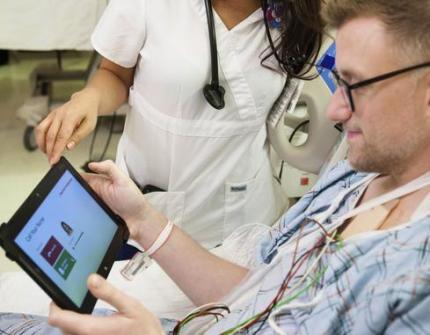
Often, hospitalized patients can be overwhelmed by the volume of information doctors and nurses share with them, but concepts like the NYP tablets hold that information for review at any time and allow patients to track their condition over time by following trends in their vital signs and other measures
More hospitals are slowly introducing similar concepts as they receive almost entirely positive feedback from patients. The vital question to answer will be the cost effectiveness of such tablets and how much hospitals would need to spend in order to introduce such systems. In the pilot test, NYP deployed tablets to two surgical nursing units with 69 beds, providing each bed with a tablet. It has proven cost-effective, taking advantage of existing network infrastructure. NYP says it’s spending $500,000 on software development, whereas it estimated the cost of additional lines to the nurse call system at $40 million.
It is not for nothing that, when Steve Jobs was once asked in what sector he sees the next big revolution his answer was the combination of Health Care and Technology.The goal is to do for medical devices what Steve Jobs did for phones. NYP has taken a step in the right direction.
“The best training I ever got for running a company was being president of my fraternity. Leadership skills come from doing, not reading.
I had to deal with everything from litigation, to fundraising, to collecting dues, to accepting and kicking out members, to planning social events.
Doing that at age 19 was the best training I ever had.”
-Marc Suster, 2x entrepreneur turned VC and General Parner at Upfront Ventures
Check out Mark Suster’s blog as well. Worthwhile reading!
Uber, Blacklane and Co. run into headwind from taxi lobbyists

Taxis and limousines – what could have been expected to be an explosive blend seems to have plenty potential for conflict. Most recently, a taxi driver association in Berlin proceeds against chauffeur service Blacklane.
As more and more limousine and chauffeur-services have popped up in recent years, the taxi industry is alarmed and ready to put up a fight with (relatively) new, innovative start ups like Blacklane, Uber and MyDriver that are trying to steal market share away from them. The transportation market, especially in Germany, is highly regulated. The Passenger Transportation Act (“Personenbeförderungsgesetz”) regulates the environment for public transportation and sets out the rules. In order to protect the taxi industry, limousine services are for example not permitted to offer spontaneous rides to passengers in Germany. Thanks to numerous Online-Apps though, limousines can be directed to the next waiting customer via our smartphones, bypassing the just-mentioned. More and more, limousine and chauffeur-services are levering out the privileges that were held for decades by the taxi industry.
In the most recent case, the taxi association of Berlin-Brandenburg had complained about the fact that the new Blacklane Smarts only have one door, as taxis and rental cars need two doors on their right side due to safety reasons. Blacklane counters accordingly with a special permission of the Berlin State Office for Public Order of affairs, stating that “Smarts do not have a rear bench seat and because of that, all passengers can enter and exit the vehicle safely.”
Another recent dispute between Uber, Chauffeur Privè and several taxi drivers in Paris far exceeded the category lobbying. The striking and furious taxi driver, as reported by the Rheinische Post, are said to have thrown paint buckets at cars of the two companies, slashed their tires, broken windows and injured at least one passenger.
After all, the poor attempts of the taxi industry to hamper the irruption of new competitors into the transportation market won’t be successful. The revolution of the transportation market, with more and more concepts penetrating the market, has already advanced too far. Instead, the taxi industry should take on the fight and be encouraged to defend their market share. The taxi companies need to work on their service and quality in order to keep passengers. As of today, the taxi industry has a turnover that is three times the turnover of the limousine industry – but that could change.
Especially in big cities where the number of people owning a car is declining, the people rely on alternative mobility options: car-sharing for example but also limousine and chauffeur services are growing in demand. The innovative offers reflect the spirit of the time, while the coolness factor of a taxi ride is virtually zero. In addition to that, many business travelers have gotten used to the limousine service in the US and are looking for the same in cities like Berlin. Cabbies – look out! Here comes the future.
Picture: Blacklane
LinkedIn co-founder Konstantin Guericke becomes partner at Earlybird
Germany-based VC Earlybird strengthens its ties to the US start-up market as Konstantin Guericke, series entrepreneur and co-founder of LinkedIn, formally joins the company full-time. Having been a venture partner and adviser for the past two years, Guericke will now act as a development and support partner for portfolio companies. Working from Silicon Valley, he will try to bridge the gap between the US and Europe. Most German VC firms lack a significant presence in the US up to this point, so why not give a Germany firm a credible Silicon Valley presence to negotiate joint investments and help portfolio companies make an impact stateside.

The move comes as Earlybird announces a package of services for its portfolio companies, which include productivity app Wunderlist, photo-sharing app EyeEm and ride-sharing platform Carpooling.com.
Earlybird aims to increase productivity and connectivity among its portfolio companies by organizing curated portfolio meet-ups, master classes and networking events, plus online access to special service provider deals, reference materials and the ability for firms to exchange information about best practice. A consolidated human resources database for the entire portfolio will follow in the future.
Having grown up in Germany, Guericke is now responsible for reinforcing the presence of Earlybird’s portfolio companies where the big VC money lies: California and especially Silicon Valley. His fluency in German should not hamper this undertaking.
 boldventureblog