Month: July 2014

The Shifting VC Landscape.

shifting VC landscape


Great post by Mark Suster, Entrepreneur and Partner at Upfront Ventures, about how the VC landscape has changed during the past years and connected dangers and opportunities. Worthwile reading!


Summary:

Cheap, mobile, social, global, always-on, one-click-purchase =

Unprecedented revenue growth + companies staying private longer =

More opportunities than ever in history for venture capital firms =

Lots of new entrants moving to capture this value =

Amazing opportunities + Risks + Uncertainties for the coming decade.


Be sure to read the whole post and check out the deck at his blog Both Sides of the Table.


The EU Is Sponsoring Your Startup. For Free.

Euros


The European Commission presented details of a new €100 million “Fast Track to Innovation” (FTI) pilot action and five innovation prizes under Horizon 2020, the European Union’s €80 billion research and innovation programme. The FTI aims to support Europe’s economy by offering innovative businesses and organisations grants to give a final push to get great ideas to market. The prizes offer a reward for technological breakthroughs of high societal relevance. The initiatives underscore the drive to support innovation in Europe as part of the first, two-year Horizon 2020 work programme. So, it appears the EU Commission has got religion about the new tech world. Let’s see what the details are:

Who can apply?

Applications are welcome from owner-managed company based in the EU, which have developed innovative products or services and are now looking for additional capital for project financing. Other requirements are that the company has an annual turnover of less than EUR 50 million and fewer than 250 employees. The funded industries range from R&D driven biotech and energy companies up to the FinTech apps that would save costs for EU companies. The added value and innovative nature of the start-ups is what counts.

How much money do I get?

The grants are divided into different categories. Smaller amounts of funding of up to € 50,000 may be requested for the purpose of idea validation. Funding of half a million to € 2.5m are primarily for scaling of ideas or growth realization. There is no repayment obligation, which makes the funds all the more attractive. The financial aid is in fact not recognized as a loan but as equity excluding a transfer of shares of the company.

Where’s the catch?

There is no catch. The EU expects a very high demand. The competition is not sleeping. Therefore, the formal and substantive requirements of the application are very high. Each smallest form of error or inadequate answers to the questionnaire will result in disqualification. The content of the application will be evaluated by external industry experts on a point system. The main evaluation categories are:

  • Innovation Excellence (innovation and planned project implementation)
  • Impact (the expected contribution of start-ups in the sector and EU) and
  • Quality (the planned resource utilization of funds)

How can I apply?

The application portfolio provides a maximum ten-page pitch deck and answering a questionnaire. But beware – The principle of awarding points is: “In God we trust, all others bring data”. The deck should be strong in number and based on facts and portray the idea of ​​milestones, objectives, and resource utilization of the project clear and realistic. A detailed description of the added value and industry impacts of start-ups is essential. For funding in the amount of €0.5 to €2.5 million, a detailed business plan is needed.

When can I apply?

Every year there are four application rounds. The next dates are September 24th and December 17th 2014. Your startup has to apply to a certain round (so-called “Calls”), which are published on the website of Horizon 2020. The calls are aimed at different topics and industries – find your perfect call and off we go. The application costs nothing. On the Horizon 2020 site, you can get a first overview of the EU initiative and the current call.

Former Rivals Becoming Friends

apple ibm

Apple and IBM are putting aside a rivalry started at the dawn of the personal-computing era to get more businesses to embrace iPhones and iPads. The two former rivals today announced a broad partnership to help companies deploy wireless devices and business-specific applications to run on them.

More than 100 new apps for iPhone and iPad will be programmed to represent various business process. IBM will also offer customized cloud services specifically designed for Apple devices  and sell its customers iPhones and iPads.The deal could be a major growth factor for Apple: IBM is a major provider of IT services and technology equipment provider. Thus it could also be an important distribution channel for Apple. IBM Services will also offer an around the clock service for Apples devices. IBM for its part, lately having recorded stagnating sales could use a new impetus as well. Apple’s devices could act as a carthorse for the sale of IBM services. Seems like a win-win situation for both Companies.

The partnership is all the more spectacular because Apple once stood at loggerheads with IBM. When Apple developed its first personal computer in the mid-70s, IBM was the industry veteran and powerful rival – it was not foreseeable that in the end Microsoft Windows, would dominate the PC industry. 30 years ago, Apple’s legendary “1984” commercial spot was directed against an IBM dictatorship, the young founder Steve Jobs had his picture taken with a stinky finger under an IBM logo.

Nowadays there are no more overlaps between the business of the two Companies according to Apple’s Cook and IBM CEO Rometty. IBM sold its PC business about a decade ago to the Chinese company Lenovo. Although Apple sells its devices to companies, it  does not provide enterprise software. Cook told the technology blog “Recode”, Apple and IBM fit together like puzzle pieces.

Coming to an agreement with your archrival that will benefit both sides is a pretty bold idea in my opinion. Well done Apple and IBM. Now the partnership just has to pay off in the long term. We’ll be there to assess if it did. Check out the video below to find out what Cook and Rometty had to say about the partnership:

http://plus.cnbc.com/rssvideosearch/action/player/id/3000292886/code/cnbcplayershare


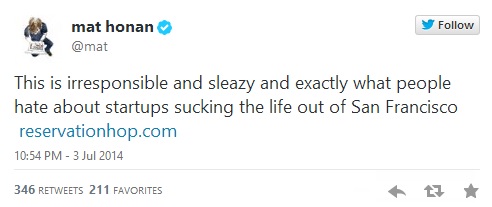
ReservationHop faces twitter shitstorm for business model

Reservation Hop

Everyone seems mad at ReservationHop. I mean, it’s not quite the hottest topic on Twitter, but among the folks who have heard about it, the idea seems to have unleashed a shitstorm of creativity.

The idea, basically, is that ReservationHop will help users get a table at in-demand restaurants. How? The company will make reservations in advance, and then allow users to claim those reservations up until four hours ahead of time, for a price. (The startup says pricing starts at $5.)

Twitter ReservationHop

To be clear, there have been some positive responses, and some neutral ones, but I think it’s fair to say that most of the tweets, particularly the most passionate ones, have been intensely negative. And beyond Twitter, Josh Ong at The Next Web described the idea as “sleazy” and as “tech enabled scalping.”

Others have noted that this could make it even harder for folks who don’t want to use ReservationHop to get a reservation, and have compared it to apps that basically allow users to sell street parking. At least ReservationHop isn’t dealing with public property, so isn’t likely to run into the same legal problems as those parking apps.

Despite the slams, ReservationHop founder Brian Mayer defended the concept itself. He pointed to other startups like Zurvu and Killer Rezzy that do something similar and to restaurants like Alinea that offer pre-paid tickets. He also said that he’s open to working directly with restaurants (which should help avoid one of the more awkward things about the current system — the fact that you have to claim a reservation that’s under a different name).

“There are a lot of claims that we are selling something that’s ‘free,’ Mayer added. “But if you think about it, there’s nothing free about restaurant seating. There’s a limited number of tables in high demand and there are very long wait times for walk-ins.”

Personally, I found the response to ReservationHop as interesting, or at least as entertaining, as the idea itself. Something about it must have struck a nerve of the people in the Bay Area. It will be interesting to see if and when the concept will be implemented in Europe. ReservationHop lists only US cities such as Boston, NYC or Seattle on their website as their next targets. More to come…