
The new feature “Startup’s made in Germany” features interesting, upcoming ventures and tells their story on boldventureblog.com. The first release will feature three promising startups from Germany’s secret Startup capital “Hamburg”. Stay tuned…
The new feature “Startup’s made in Germany” features interesting, upcoming ventures and tells their story on boldventureblog.com. The first release will feature three promising startups from Germany’s secret Startup capital “Hamburg”. Stay tuned…

After months of back and forth the conflict between Uber and Europe’s biggest economy seems to have come to an end: On Wednesday a German court ruled that Uber violates the nation’s taxi laws and has imposed a nationwide ban on the ride-sharing service, uberPOP.
The Frankfurt regional court sided with Taxi Deutschland, a taxi union that has been fighting Uber in the courts since August 2014. Uber however is not planning on giving up just yet. The company released a statement this week saying that it is planning to appeal the ban.
It will be interesting to see, how the company tries to wiggle its way around lawmakers this time. We will most certainly take a close look at it.

Now that the World Cup is over and most of the hype in Brazil is gone one very important question remains: What to do with all the empty soccer stadiums?
Of the twelve stadiums that Brazilian cities built or renovated for the 2014 World Cup, four have futures that look dismal. Situated in a rain forest in one case, in a city without a top-tier soccer team in another, these stadiums will likely struggle to attract the crowds needed to support their massive upkeep costs. That can’t help but make one wonder: Was the $2 billion that went into building them a colossal waste?
Maybe, but perhaps Brazil can come up with a plan to put the hulking structures to good use. “Casa Futebol,” an architectural proposal from the visionaries at 1 Week 1 Project, is probably not that plan, but its heart is in the right place. They’d like to convert the stadiums into much-needed housing complexes, leaving the fields untouched so people can still enjoy the occasional soccer game.
Axel de Stampa et Sylvain Macaux, architects based both in France and Chile, are responsible for the whimsical collaboration 1 Week 1 Project. The project, called Casa Futebol, would put an estimated 1,000 to 2,000 1,130-square-feet housing units into each new stadium, resulting in roughly 20,000 homes. Here’s the duo laying out their grand scheme:
…within the host country, the housing shortage is estimated to be at 5.2 million homes according to the institute of applied economic research. by analyzing the current structures of the athletic venues, the architects envision the possibility for alternative modes of housing that counteract the deficit to be placed within their spaces. the existing architecture requires mass amounts of light for its activities along with a common repetition of construction components that evenly divide spaces. these typological characteristics allow the dispersement of modules throughout the perimeter, where residents can have sunlit views to the interior and exterior. meanwhile, soccer games will continue to be played and watched by people from the city, where a portion of the profits can be used to finance the maintenance of the residences.
Macaux believes that the World Cup stadiums are so massive that “it is almost absurd.” And this high-concept design could easily accommodate many of the 250,000 people displaced by the World Cup. Despite the fact that this is being called an insane idea that would never become reality, I believe that Casa Futbol is a particularly exciting idea given Brazil’s serious issues with poverty and human displacement (two issues exacerbated by the 2014 World Cup). Hopefully, Macaux and de Stampa can turn this idea into a reality.
Check out the illustrations below:




Great post by Mark Suster, Entrepreneur and Partner at Upfront Ventures, about how the VC landscape has changed during the past years and connected dangers and opportunities. Worthwile reading!
Summary:
Cheap, mobile, social, global, always-on, one-click-purchase =
Unprecedented revenue growth + companies staying private longer =
More opportunities than ever in history for venture capital firms =
Lots of new entrants moving to capture this value =
Amazing opportunities + Risks + Uncertainties for the coming decade.
Be sure to read the whole post and check out the deck at his blog Both Sides of the Table.

The European Commission presented details of a new €100 million “Fast Track to Innovation” (FTI) pilot action and five innovation prizes under Horizon 2020, the European Union’s €80 billion research and innovation programme. The FTI aims to support Europe’s economy by offering innovative businesses and organisations grants to give a final push to get great ideas to market. The prizes offer a reward for technological breakthroughs of high societal relevance. The initiatives underscore the drive to support innovation in Europe as part of the first, two-year Horizon 2020 work programme. So, it appears the EU Commission has got religion about the new tech world. Let’s see what the details are:
Who can apply?
Applications are welcome from owner-managed company based in the EU, which have developed innovative products or services and are now looking for additional capital for project financing. Other requirements are that the company has an annual turnover of less than EUR 50 million and fewer than 250 employees. The funded industries range from R&D driven biotech and energy companies up to the FinTech apps that would save costs for EU companies. The added value and innovative nature of the start-ups is what counts.
How much money do I get?
The grants are divided into different categories. Smaller amounts of funding of up to € 50,000 may be requested for the purpose of idea validation. Funding of half a million to € 2.5m are primarily for scaling of ideas or growth realization. There is no repayment obligation, which makes the funds all the more attractive. The financial aid is in fact not recognized as a loan but as equity excluding a transfer of shares of the company.
Where’s the catch?
There is no catch. The EU expects a very high demand. The competition is not sleeping. Therefore, the formal and substantive requirements of the application are very high. Each smallest form of error or inadequate answers to the questionnaire will result in disqualification. The content of the application will be evaluated by external industry experts on a point system. The main evaluation categories are:
How can I apply?
The application portfolio provides a maximum ten-page pitch deck and answering a questionnaire. But beware – The principle of awarding points is: “In God we trust, all others bring data”. The deck should be strong in number and based on facts and portray the idea of milestones, objectives, and resource utilization of the project clear and realistic. A detailed description of the added value and industry impacts of start-ups is essential. For funding in the amount of €0.5 to €2.5 million, a detailed business plan is needed.
When can I apply?
Every year there are four application rounds. The next dates are September 24th and December 17th 2014. Your startup has to apply to a certain round (so-called “Calls”), which are published on the website of Horizon 2020. The calls are aimed at different topics and industries – find your perfect call and off we go. The application costs nothing. On the Horizon 2020 site, you can get a first overview of the EU initiative and the current call.
Ryan Grepper from Portland, Oregon was sick of the traditional cooler. The regular cooler we know break easily and was just a pain to carry around on trips, so he came up with this brand new concept. Just watch and see what his new invention can do.

Apple and IBM are putting aside a rivalry started at the dawn of the personal-computing era to get more businesses to embrace iPhones and iPads. The two former rivals today announced a broad partnership to help companies deploy wireless devices and business-specific applications to run on them.
More than 100 new apps for iPhone and iPad will be programmed to represent various business process. IBM will also offer customized cloud services specifically designed for Apple devices and sell its customers iPhones and iPads.The deal could be a major growth factor for Apple: IBM is a major provider of IT services and technology equipment provider. Thus it could also be an important distribution channel for Apple. IBM Services will also offer an around the clock service for Apples devices. IBM for its part, lately having recorded stagnating sales could use a new impetus as well. Apple’s devices could act as a carthorse for the sale of IBM services. Seems like a win-win situation for both Companies.
The partnership is all the more spectacular because Apple once stood at loggerheads with IBM. When Apple developed its first personal computer in the mid-70s, IBM was the industry veteran and powerful rival – it was not foreseeable that in the end Microsoft Windows, would dominate the PC industry. 30 years ago, Apple’s legendary “1984” commercial spot was directed against an IBM dictatorship, the young founder Steve Jobs had his picture taken with a stinky finger under an IBM logo.
Nowadays there are no more overlaps between the business of the two Companies according to Apple’s Cook and IBM CEO Rometty. IBM sold its PC business about a decade ago to the Chinese company Lenovo. Although Apple sells its devices to companies, it does not provide enterprise software. Cook told the technology blog “Recode”, Apple and IBM fit together like puzzle pieces.
Coming to an agreement with your archrival that will benefit both sides is a pretty bold idea in my opinion. Well done Apple and IBM. Now the partnership just has to pay off in the long term. We’ll be there to assess if it did. Check out the video below to find out what Cook and Rometty had to say about the partnership:
http://plus.cnbc.com/rssvideosearch/action/player/id/3000292886/code/cnbcplayershare

Everyone seems mad at ReservationHop. I mean, it’s not quite the hottest topic on Twitter, but among the folks who have heard about it, the idea seems to have unleashed a shitstorm of creativity.
The idea, basically, is that ReservationHop will help users get a table at in-demand restaurants. How? The company will make reservations in advance, and then allow users to claim those reservations up until four hours ahead of time, for a price. (The startup says pricing starts at $5.)
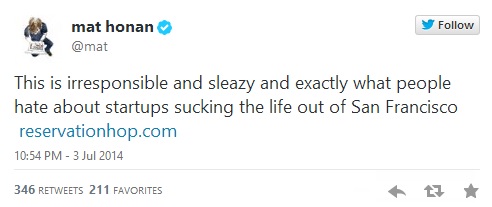
To be clear, there have been some positive responses, and some neutral ones, but I think it’s fair to say that most of the tweets, particularly the most passionate ones, have been intensely negative. And beyond Twitter, Josh Ong at The Next Web described the idea as “sleazy” and as “tech enabled scalping.”
Others have noted that this could make it even harder for folks who don’t want to use ReservationHop to get a reservation, and have compared it to apps that basically allow users to sell street parking. At least ReservationHop isn’t dealing with public property, so isn’t likely to run into the same legal problems as those parking apps.
Despite the slams, ReservationHop founder Brian Mayer defended the concept itself. He pointed to other startups like Zurvu and Killer Rezzy that do something similar and to restaurants like Alinea that offer pre-paid tickets. He also said that he’s open to working directly with restaurants (which should help avoid one of the more awkward things about the current system — the fact that you have to claim a reservation that’s under a different name).
“There are a lot of claims that we are selling something that’s ‘free,’ Mayer added. “But if you think about it, there’s nothing free about restaurant seating. There’s a limited number of tables in high demand and there are very long wait times for walk-ins.”
Personally, I found the response to ReservationHop as interesting, or at least as entertaining, as the idea itself. Something about it must have struck a nerve of the people in the Bay Area. It will be interesting to see if and when the concept will be implemented in Europe. ReservationHop lists only US cities such as Boston, NYC or Seattle on their website as their next targets. More to come…
A consolidation in the German Incubator scene has been anticipated since the end of 2013 and now with EPIC Companies, the second large German-based Incubator has reduced its staff and consolidated its activities, as reported by Venture Village. Previously, Bertelsmann had quietly closed the doors of its incubator Bevation and Team Europe had announced a change in strategy in order to reduce its overhead costs.
Despite EPIC company’s appeasement-strategy and assurance that its employees will mostly be transferred to its portfolio companies and that there will be only a very small number of layoffs , the reaction in the German startup-scene to the company’s’ press release last week have been rather negative. The rationale behind EPIC boss Mato Peric’ decision is simple: relatively high overhead costs and a cost-benefit-ratio that would have put the incubator under immense pressure in the next few years. “We did not want to be in a position where we needed to constantly launch new companies only to justify a big overhead”, Peric told the Berliner Morgenpost. The number of employees at Epic Companies also grew fast. “We are more than 200 employees across all portfolio companies, and we will remain more than 200”, Peric added. It sounds like the only thing that will change is the allocation of EPIC’s workforce, as many of the employees will be transferred from the Holding to the individual portfolio companies and therefore be released from EPIC’s payroll.

In addition to reduced overhead costs, the incubators’ recent decision is part of a targeted long-term change in strategy. Interesting to see will be how the incubator will be positioned from now on. Even though, Peric says that the portfolio (EPIC currently has 7 startups in its portfolio) will not change, rumors are that EPIC will mainly focus on investments in promising startups while building fewer ventures from scratch. EPIC Companies is not the only incubator who is contemplating a change of mind like that: Berlin-based Team Europe already signaled significant changes to its business strategy (resulting in staff cuts) in late 2013 – the incubator announced a downsizing in activities, with an aim of co-founding just two “fast-growing and sustainable” internet companies per year.
On the one hand, 2013 has been a hyped-up year for Incubators in Germany, which is why a consolidation seemed to be inevitable. On the other hand, the overall market situation became much more intense in terms of competitive pressure. Competing incubators, accelerator programs and other funding programs for startups – everyone wanted a piece of the cake. All of a sudden, founders had numerous options for their startups to choose from and often ended up choosing another funding model. Most incubators got under a lot of pressure and were not able to generate Exits in order to compensate for their high operating costs.
Swimming against the stream
A general turning-away from the incubator-model however is not very likely. Besides a few recent negative developments there are also promising signs: As one of the first investors from the pharma-industry Bayer AG, the German pharmaceutical giant, announced an investment in the High-Tech Gründerfonds II, the famous German early stage seed investor, and founded its own incubator CoLaborator in Berlin in early 2014. CoLaborator focuses on early stage biotech start ups and provides office space as well as sophisticated know-how in the area of bio-technology. Another newly established incubator with a special niche focus is the Frankfurt-based main incubator, through which the Commerzbank aims to bring innovations to the banking industry. The incubator supports fin-tech startups and founders with capital and access to the Commerzbank-infrastructure.
Quo vadis?
Observing the most recent developments in the German Incubator scene, it seems as if there are two strategies at present: Either to address a specific target group, with a strong connection to the core business, or to diversify the investment approach. Diversification in this respect ranges from developing completely new ideas from scratch to predominantly focusing on investments in promising business models. The imaginary line between incubators and company builder seems to be rather blurry anyway: Rocket Internet, for example, clearly describes itself as an incubator on their website, while Project A calls itself a company builder.

There has been a lot of noise lately whether Germany is a favorable environment for startups and entrepreneurs and in what way the conditions for young companies located here could be improved. The wide-spread public opinion: too much regulation, not enough capital and a general culture that is too risk-averse to bring up innovations. The BVK, Federal Association of German Capital Association, has now come forward with a new proposal that would favor more Venture Capital investments in Germany.
“In order to make Germany internationally more attractive as an investment destination for venture capital, we will issue a new set of rules (Venture Capital Act) depending on funding opportunities.” This has been written down in the coalition agreement between CDU, CSU and SPD in fall 2013. The German Bundestag now urged the Federal Government, to improve the conditions for venture capital in this legislative period. The BVK has proposed a draft bill, that includes a series of actions, most notably:
In the last three years startups in Germany received almost EUR 2bn in Venture Capital – a decent plus of 19% (reported by the BVK). That might seem like a lot of money, compared to the EUR 64bn in the same period for the U.S. however, the amount is quite low. The proposed measures for a Venture Capital Fund Law in Germany are intended to enhance the investment environment for all parties – Fund investors, fund sponsors and portfolio companies. A constantly changing industry like the startup industry needs a flexible regulatory environment in order to stay competitive. The German regulatory authorities are said to be anything but flexible. The BVK bill proposal is a step in the right direction. A first step with a lot of ground to cover…
 boldventureblog