bold ideas

Wundercar takes car-sharing in Germany to the next level

Have you ever wished for a taxi-like experience, but without the cost and depressing atmosphere of an actual taxi ride? Wundercar might have found the answer to that wish and started with an App last month in Hamburg and Berlin. The Hamburg-based startup founded by Gunnar Froh (former Airbnb) describes itself as a ride-sharing service offering more than just a simple ride from A to B but an urban experience with local drivers. The corresponding slogan: Catch a ride – Create a story.

For those of you not familiar with the ride-sharing economy, ideas like Wundercar’s aren’t exactly new – examples like Lyft or Sidecar are two relatively well-known services that are already operating in the US. However, in Europe there seems to be a lack of short-ride sharing hops. There are short time rental services like Car2Go and DriveNow, or companies like BlaBlaCar and Mitfahrgelegenheit for longer journeys but nothing yet that really offers an on-demand service.

Image


The Wundercar model is pretty simple. All rides are on-demand and free by default. If the passenger thinks the driver and journey were worth paying for, they give a donation. The corresponding App suggests a certain donation (based on what other passengers donated for the same distance) and Wundercar will take a 20 percent cut. That way, Wundercar bypasses all the recent turmoils about regulatory issues in the car-sharing economy in Germany.

And for those that simply never pay for their rides, there is a feedback system for passengers and drivers. Too many bad reviews and there’s a good chance that people will simply stop picking you up. The same goes for drivers: only Wundercar pre-certified drivers with primarily positive feedback are allowed into the community. “At the end of the ride it’s up to the guest if they want to make a donation to the driver. The basic assumption is that you ride for free, but if you liked it you can make a donation through the app, but you have to keep in mind that the driver will rate the guest at the end”, Froh told TNW.

While Wundercar is launching its service first in Berlin and Hamburg, the Company is already targeting other German locations as well as international cities like London – a metropolis with virtually no viable alternative to incredibly expensive cab rides for short hops across town. The climate for expansion seems favorable, as Wundercar has secured a seven-digit seed funding amount in late 2013 and with no other competition in Europe in sight.

Froh’s experience at Airbnb will help the Company to fight against upcoming regulatory hurdles that may arise in the future. “With Airbnb, I spent a good part of my time meeting with city representatives in Hamburg, Berlin and other cities…making proposals for how to adapt local regulations, and we’re now again doing that in this context” he said in an interview with TNW. Having managed to become a viable, safe alternative to unnecessarily expensive cab rides in Berlin and Hamburg already represents quite an achievement for a company that has been founded only in fall 2013. I truly hope that they can pull off to bring their model to other cities as well – Car sharing 2.0 at its best.


Picture: © Wundercar.org

Recycling platform for failed startups Rehype goes live

Image


9 out of 10 startups fail. This simple rule is ubiquitous and is keeping many entrepreneurs from even trying their luck. Rehype.it is a new platform that aims to capitalize on that fact. The project, which started earlier this month, provides failed startups with a second chance. Participants can sell brands, domains or a complete businesses through the marketplace. The website sardonically states: “Your startup is insolvent – so what? With Rehype.it you can now turn every part of your project into cash.”

Tom Schneider, founder of Rehype explains the idea behind his startup: “Our concern is that, what has been created in many projects is not simply buried and thrown away, but that other people might be able to do something with it. People who may have better contacts or financial resources or an idea to take things a little differently.” He also points out that Rehype “is not just about failed start-ups, but also about projects that are already advanced, but cannot be continued for some reason.”

So if you are looking to get your hands on a few ideas (failed for whatever reason) or just want to be inspired by projects of other people, Rehype might be the place to check out. The market place grants its users an early bird special that includes free membership for the first 90 days after its inauguration. I’m already signed up. How about you?

Picture: © Rehype.it

Back to the roots for startups: Good ol’ fashioned German engineering know-how

Dash In Ear Headphones

Whenever there is talk of a innovative ideas these days, people almost inevitably tend to think of a groundbreaking app or software that is being developed by tech experts from the Valley or Berlin. Not this time though. Bragi, a hardware-centered startup based in Munich, is drawing fresh attention to the promise of good ol’ fashioned German engineering know-how through their most recent innovation.

You’ve heard of smartphonessmartwatches, and maybe even smartpants, but the German startup Bragi has just used Kickstarter to gather steam for an entirely new concept: smart headphones. The so-called Dash headphones raised over USD 3.3million, therefore exceeding the original goal USD 260,000 by 1,300%. So the question comes to mind: What makes the Dash headphones so special?

Image


Well, first off not only do they offer the usual slate of advanced features like Bluetooth wireless connectivity and a built-in mic, they perform all sorts of functions that have nothing to do with audio. As visualized in the image above, the Dash has three main functions: Listen, Track, Communicate.

Listen

Even if you have no interest in using the Dash for their athlete-focused properties, the smart headphones offer up even more impressive features. For instance, the headphones offer passive noise isolation to say, let you sleep on a plane, but you can also turn on “audio transparency” to pass through ambient noise when you need it, like riding a bike. The Dash are completely water-resistant (the video shows a surfer using the ‘phones) and an embedded 4GB music player can hold roughly 1,000 songs to play when you don’t have a phone connected.

Track

The Dash tracks the body’s performance during exercise, monitoring speed, time, distance and cadence, as well as heart rate, oxygen saturation and energy spent. All of these statistics are monitored in real-time while acoustic feedback is provided in the background. For instance, a demo video for the Dash shows a skier hearing his heart rate, speed, drop rate, pulse and pace during a run. Apparently the headphones achieve this with some very delicate little tools: a 3-axis accelerometer, infrared LED and optical sensor, a five-field capacitive sensor, and even a 32-bit ARM processor like you might find in a smartphone. It even works without an attached smartphone.

Communicate

In addition to being earphones, the Dash can also double as a Bluetooth Headset delivering clear voice quality through the embedded ear bone microphone. A swipe on the capacitive touch surface will enable or disable ambient sound to pass through. The Dash has an ambient microphone in the left and right ear phone. It records, when needed, a wide frequency range, from engine noise to birds singing and also promises to be able to translate foreign languages in real time.


According to rankings on Kickstarter, the campaign is the largest donation-based funding drive by a European start-up to date —a milestone for the German tech scene. The Dash headphones can be pre-ordered for USD 299 over the offical website. I don’t know about you but I’ve been waiting for a product like this for a very long time. Sleek German engineering paired with multinational design and usability sound pretty promising – the price however, not so much.


Pictures: © bragi.com

Google follows Facebook by acquiring the auspicious drone startup Titan

ImageGoogle has acquired Titan Aerospace, the drone startup that makes high-flying robots which was previously scoped by Facebook as a potential acquisition target, the WSJ reports. The details of the purchase weren’t disclosed, but the deal comes after Facebook disclosed its own purchase of a Titan Aerospace competitor in U.K.-based Ascenta for its globe-spanning Internet plans earlier this year in March.
Both Ascenta and Titan Aerospace are in the business of high altitude drones, which cruise nearer the edge of the earth’s atmosphere and provide tech that could be integral to covering the globe in cheap, omnipresent Internet connectivity to help bring remote areas online. According to the WSJ, Google will be using Titan Aerospace’s expertise and tech to contribute to Project Loon, the balloon-based remote Internet delivery project it’s currently working on along these lines.

That’s not all the Titan drones can help Google with, however. The company’s robots also take high-quality images in real-time that could help with Maps initiatives, as well as helping monitor environmental damage like oil spills and deforestation and contribute to things like “disaster relief”, a Google spokesperson tells WSJ. The main goal, however, is likely spreading the potential reach of Google and its network, which is Facebook’s aim, too. When you saturate your market and you’re among the world’s most wealthy companies, you don’t go into maintenance mode; you build new ones.

As for why an exit to Google looked appealing to the New Mexico-based company Titan, whose drones are capable of flying at a reported altitude of 65,000 feet for up to three years, one has to take into consideration that there was also a lot of risk involved that would’ve made it difficult to find sustained investment while remaining independent. Google enables the founders to do just that: continue their research, testing and design work as part of the Google family and not having to worry about raising money from other VC’s anymore.

Titan Aerospace also represents just the latest in a string of robotics acquisitions Google has been making lately, which include Boston Dynamics and seven other companies purchased to help fuel its experimental robotics program. There’s no question Google is eager to stay ahead of competition like Facebook. And thanks to Loon ambitions, the reasoning behind the Titan buy might just be the most transparent yet.

Don’t know what to do with your degree and haven’t found you dream job yet? Karista, a career- and job-portal for recent and soon-to-be Graduates will be making its start in May 2014. The project is led by the founders of meinpraktikum.de and Ausbildung.de. “The portal is supposed to solve the essential problem for students: figuring out what to do and which jobs to apply for, with their degree” says Joschka Felten, CEO of Karista. A job-navigator will help students to find relevant jobs that match their degree. So far, so good. But what’s the new approach that differentiates Karista from other job search pages? “Besides providing the students with the suitable profession based on their degree, we also list currently open positions in that particular area of interest” promises Felten. That would indeed be a new approach that has not been seen before…

Patient tablets in hospitals will revolutionize the way we access our personal health data

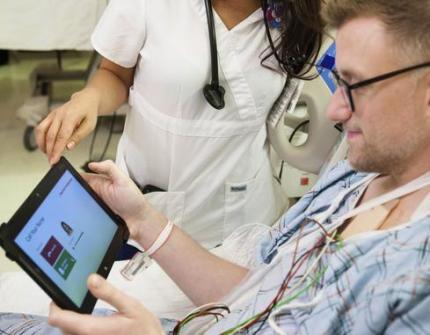
New York-Presbyterian Hospital’s (NYP) bedside tablet project replaces traditional nurse call buzzers with tablets that patients can also use to access personal health data. The hospital has operated a MyNYP.org website based on Microsoft HealthVault since 2009, but it’s been a personal health records portal for patients to use from home.

Now the portal is also an in-patient bedside communications tool. Patients are often barraged by information, and the tablets let them browse information about their condition through the portal. The Windows 8 tablets, combined with two custom built Windows 8 apps, enable patients to seamlessly communicate with their care-team and quickly access their health information. When patients use the tablets to call for help, they can be more specific, helping nurses cut down on the clamor associated with the old system. Image

Often, hospitalized patients can be overwhelmed by the volume of information doctors and nurses share with them, but concepts like the NYP tablets hold that information for review at any time and allow patients to track their condition over time by following trends in their vital signs and other measures

More hospitals are slowly introducing similar concepts as they receive almost entirely positive feedback from patients. The vital question to answer will be the cost effectiveness of such tablets and how much hospitals would need to spend in order to introduce such systems. In the pilot test, NYP deployed tablets to two surgical nursing units with 69 beds, providing each bed with a tablet. It has proven cost-effective, taking advantage of existing network infrastructure. NYP says it’s spending $500,000 on software development, whereas it estimated the cost of additional lines to the nurse call system at $40 million.

It is not for nothing that, when Steve Jobs was once asked in what sector he sees the next big revolution his answer was the combination of Health Care and Technology.The goal is to do for medical devices what Steve Jobs did for phones. NYP has taken a step in the right direction.