
The new feature “Startup’s made in Germany” features interesting, upcoming ventures and tells their story on boldventureblog.com. The first release will feature three promising startups from Germany’s secret Startup capital “Hamburg”. Stay tuned…
The new feature “Startup’s made in Germany” features interesting, upcoming ventures and tells their story on boldventureblog.com. The first release will feature three promising startups from Germany’s secret Startup capital “Hamburg”. Stay tuned…

After months of back and forth the conflict between Uber and Europe’s biggest economy seems to have come to an end: On Wednesday a German court ruled that Uber violates the nation’s taxi laws and has imposed a nationwide ban on the ride-sharing service, uberPOP.
The Frankfurt regional court sided with Taxi Deutschland, a taxi union that has been fighting Uber in the courts since August 2014. Uber however is not planning on giving up just yet. The company released a statement this week saying that it is planning to appeal the ban.
It will be interesting to see, how the company tries to wiggle its way around lawmakers this time. We will most certainly take a close look at it.

Great post by Mark Suster, Entrepreneur and Partner at Upfront Ventures, about how the VC landscape has changed during the past years and connected dangers and opportunities. Worthwile reading!
Summary:
Cheap, mobile, social, global, always-on, one-click-purchase =
Unprecedented revenue growth + companies staying private longer =
More opportunities than ever in history for venture capital firms =
Lots of new entrants moving to capture this value =
Amazing opportunities + Risks + Uncertainties for the coming decade.
Be sure to read the whole post and check out the deck at his blog Both Sides of the Table.

Everyone seems mad at ReservationHop. I mean, it’s not quite the hottest topic on Twitter, but among the folks who have heard about it, the idea seems to have unleashed a shitstorm of creativity.
The idea, basically, is that ReservationHop will help users get a table at in-demand restaurants. How? The company will make reservations in advance, and then allow users to claim those reservations up until four hours ahead of time, for a price. (The startup says pricing starts at $5.)
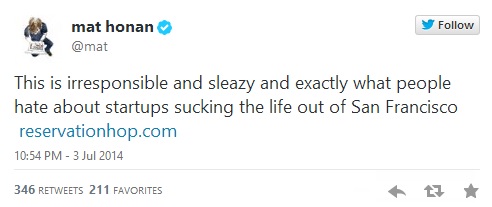
To be clear, there have been some positive responses, and some neutral ones, but I think it’s fair to say that most of the tweets, particularly the most passionate ones, have been intensely negative. And beyond Twitter, Josh Ong at The Next Web described the idea as “sleazy” and as “tech enabled scalping.”
Others have noted that this could make it even harder for folks who don’t want to use ReservationHop to get a reservation, and have compared it to apps that basically allow users to sell street parking. At least ReservationHop isn’t dealing with public property, so isn’t likely to run into the same legal problems as those parking apps.
Despite the slams, ReservationHop founder Brian Mayer defended the concept itself. He pointed to other startups like Zurvu and Killer Rezzy that do something similar and to restaurants like Alinea that offer pre-paid tickets. He also said that he’s open to working directly with restaurants (which should help avoid one of the more awkward things about the current system — the fact that you have to claim a reservation that’s under a different name).
“There are a lot of claims that we are selling something that’s ‘free,’ Mayer added. “But if you think about it, there’s nothing free about restaurant seating. There’s a limited number of tables in high demand and there are very long wait times for walk-ins.”
Personally, I found the response to ReservationHop as interesting, or at least as entertaining, as the idea itself. Something about it must have struck a nerve of the people in the Bay Area. It will be interesting to see if and when the concept will be implemented in Europe. ReservationHop lists only US cities such as Boston, NYC or Seattle on their website as their next targets. More to come…
A consolidation in the German Incubator scene has been anticipated since the end of 2013 and now with EPIC Companies, the second large German-based Incubator has reduced its staff and consolidated its activities, as reported by Venture Village. Previously, Bertelsmann had quietly closed the doors of its incubator Bevation and Team Europe had announced a change in strategy in order to reduce its overhead costs.
Despite EPIC company’s appeasement-strategy and assurance that its employees will mostly be transferred to its portfolio companies and that there will be only a very small number of layoffs , the reaction in the German startup-scene to the company’s’ press release last week have been rather negative. The rationale behind EPIC boss Mato Peric’ decision is simple: relatively high overhead costs and a cost-benefit-ratio that would have put the incubator under immense pressure in the next few years. “We did not want to be in a position where we needed to constantly launch new companies only to justify a big overhead”, Peric told the Berliner Morgenpost. The number of employees at Epic Companies also grew fast. “We are more than 200 employees across all portfolio companies, and we will remain more than 200”, Peric added. It sounds like the only thing that will change is the allocation of EPIC’s workforce, as many of the employees will be transferred from the Holding to the individual portfolio companies and therefore be released from EPIC’s payroll.

In addition to reduced overhead costs, the incubators’ recent decision is part of a targeted long-term change in strategy. Interesting to see will be how the incubator will be positioned from now on. Even though, Peric says that the portfolio (EPIC currently has 7 startups in its portfolio) will not change, rumors are that EPIC will mainly focus on investments in promising startups while building fewer ventures from scratch. EPIC Companies is not the only incubator who is contemplating a change of mind like that: Berlin-based Team Europe already signaled significant changes to its business strategy (resulting in staff cuts) in late 2013 – the incubator announced a downsizing in activities, with an aim of co-founding just two “fast-growing and sustainable” internet companies per year.
On the one hand, 2013 has been a hyped-up year for Incubators in Germany, which is why a consolidation seemed to be inevitable. On the other hand, the overall market situation became much more intense in terms of competitive pressure. Competing incubators, accelerator programs and other funding programs for startups – everyone wanted a piece of the cake. All of a sudden, founders had numerous options for their startups to choose from and often ended up choosing another funding model. Most incubators got under a lot of pressure and were not able to generate Exits in order to compensate for their high operating costs.
Swimming against the stream
A general turning-away from the incubator-model however is not very likely. Besides a few recent negative developments there are also promising signs: As one of the first investors from the pharma-industry Bayer AG, the German pharmaceutical giant, announced an investment in the High-Tech Gründerfonds II, the famous German early stage seed investor, and founded its own incubator CoLaborator in Berlin in early 2014. CoLaborator focuses on early stage biotech start ups and provides office space as well as sophisticated know-how in the area of bio-technology. Another newly established incubator with a special niche focus is the Frankfurt-based main incubator, through which the Commerzbank aims to bring innovations to the banking industry. The incubator supports fin-tech startups and founders with capital and access to the Commerzbank-infrastructure.
Quo vadis?
Observing the most recent developments in the German Incubator scene, it seems as if there are two strategies at present: Either to address a specific target group, with a strong connection to the core business, or to diversify the investment approach. Diversification in this respect ranges from developing completely new ideas from scratch to predominantly focusing on investments in promising business models. The imaginary line between incubators and company builder seems to be rather blurry anyway: Rocket Internet, for example, clearly describes itself as an incubator on their website, while Project A calls itself a company builder.

ImmobilienScout24’s start-up incubator YOU IS NOW introduces its new round. The second round of the accelerator program will include PopUp Berlin, GroupEstate and Sorglosinternet.
After completing the first round in February, the YOU IS NOW Berlin Accelerator Program will now start a second round. PopUp Berlin, GroupEstate and Sorglosinternet will develop their business ideas and will be supported by over 30 internal ImmobilienScout24 mentors and external mentors such as YouTube founder Jawed Karim who will coach the start-ups. In addition, the Founder Institute will offer workshops, seminars and pitch coaching.
Dennis Boehres, co-founder of PopUp Berlin, talked to VentureVillage about the value of the program to his startup: “We’re enthusiastic for this opportunity to accelerate the development of our platform and services and get our service on the next level of functionality, attention and traction.” PopUp Berlin is a community marketplace that connects landlord and commercial property owners to creative businesses who are looking for a popup-store to test, promote or develop their business ideas.
With GroupEstate, Founder Joel Dullroy and his team are building an online tool for the collaborative acquisition of property between friends, couples and flatmates. The tool will offer everything that is required for making a purchase: contract templates, a financial dashboard, a notary and credit finder and an investment management function.
“Personally, I am very happy to be working with ImmobilienScout24 again. They funded and supported my last startup, which unfortunately failed due to problems within the team,” says Dullroy referring to his co-founder who accused the accelerator of purposely letting the startup file for bankruptcy.
With the sorglosbox (“worry-free box”), businesses (airports, restaurants,…) can offer free wifi to their customers without fearing legal issues with providing each user their own IP address. Looking forward to the program, Wolfgang Lauterbach, co-founder and CEO atSorglosinternet told VentureVillage: “We have made our first steps as a startup. With the YIN expertise and mentoring team, we want to ensure to professionalize our processes and work on further ideas while having our first real office space.”
The focus of YOU IS NOW is on internet-based business models which are thematically linked with the Scout24 portals. According to ImmobilienScout24, the in-house incubator and accelerator program is an important component of the online business’s strategy for innovation and growth.
The program, which started in November 2013 with a first round of five teams, provides the startups with a co-working space as well as up to €15,000. While in the beginning €25,000 was given away to startups, YOU IS NOW stated that in the beginning financial support was not as necessary to startups as advice. In order to participate, the startups do not give away any shares.
“The focus of our accelerator program is on business ideas that create added value for the property industry”, states Torsten Oelke, the initiator of YOU IS NOW Berlin. “The start-ups in the second accelerator class have this potential. We are excited to see how they will develop and what sort of synergies with ImmobilienScout24 might possibly develop.”
Key Facts:
Photo: © Gruenderszene
Original story: © VentureVillage, 05-12-14
Taking a weekend city trip is a great experience, but somehow it always seems like the locals are having all the fun. You, as the stranger on the other hand, all too often miss out on so many things. If you’ve visited Berlin, Germany, and wished you knew where to find the best entertainment or the “in” places to eat, most of the time you don’t have any other choice rather than checking what your travel guide suggests. Travel guides – designed to meet the interests of the greatest possible group of people by neglecting any type of individuality. The problem to be solved here is obvious, isn’t it?
“The local experience” is what everyone hopes for when taking a trip to a foreign city. Clare Freeman, world traveller and entrepreneur, provides just that. The concept of her startup My Plus One is simple: “Most of us travel these days and often know people abroad. But if you’re going somewhere you don’t know, perhaps for business or just an adventure, it’s easy to waste time seeing the wrong places, getting lost or ending up in tourist traps”, she explains on her website. Clare has launched the city break with a difference – you not only have a choice of selected hand-picked accommodations, you also get the company of a local resident who can show you where it’s all happening.
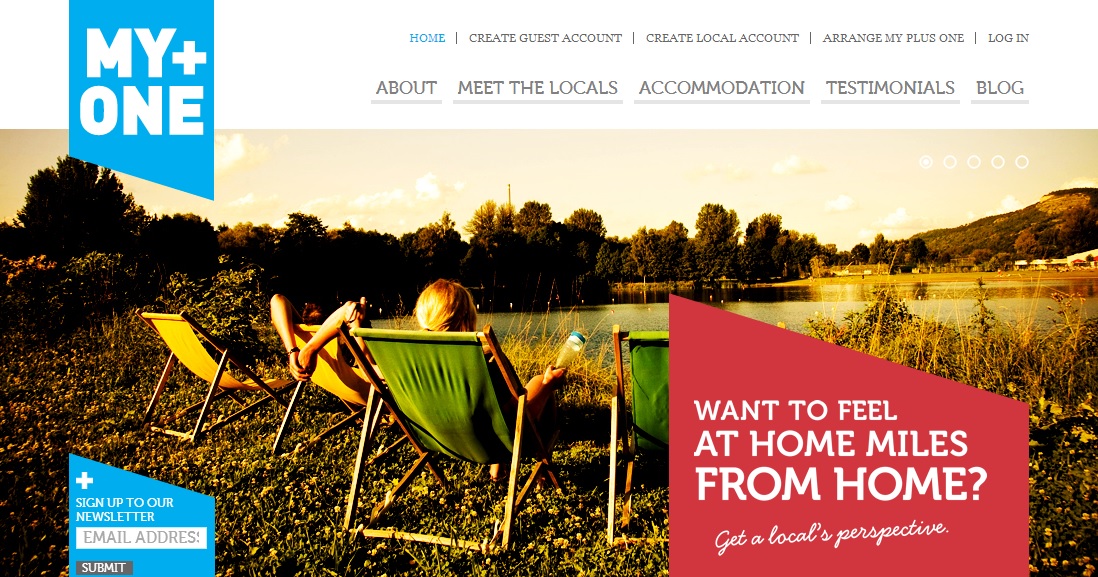
My Plus One has a selection of local guides who are chosen for their knowledge and passion of the city. When a guest makes their reservation, they choose what they wish to experience. There are many options to choose from, ranging from a coffee hangout with a local, just to get their tips and recommendations, up to a long booking when you go out with them. The costs differ (20-40€) but payment method doesn’t always have to be monetary: You may also choose to pay in the form of a gift or skill-share up to the value of the booking. For example, you could offer your Plus One an item of clothing, a bottle of wine, or perhaps a lesson in juggling! In short: it’s all a matter of negotiation between you and your local.
My Plus One launched in Berlin in March 2012 with 15 friends and one studio. Since then, the community has grown to nearly 100 locals and 14 accommodation partners across 5 cities (Berlin, London, Paris, Amsterdam and Barcelona). By now Claire has gathered a small team in Berlin, passionate about making travel more enjoyable, beneficial and interesting for all of us. What a great example of changing the way we travel by thinking outside the box. So before booking your next weekend city trip make sure to make this one a true local experience.
Picture: © http://www.myplusone.net
Have you ever wished for a taxi-like experience, but without the cost and depressing atmosphere of an actual taxi ride? Wundercar might have found the answer to that wish and started with an App last month in Hamburg and Berlin. The Hamburg-based startup founded by Gunnar Froh (former Airbnb) describes itself as a ride-sharing service offering more than just a simple ride from A to B but an urban experience with local drivers. The corresponding slogan: Catch a ride – Create a story.
For those of you not familiar with the ride-sharing economy, ideas like Wundercar’s aren’t exactly new – examples like Lyft or Sidecar are two relatively well-known services that are already operating in the US. However, in Europe there seems to be a lack of short-ride sharing hops. There are short time rental services like Car2Go and DriveNow, or companies like BlaBlaCar and Mitfahrgelegenheit for longer journeys but nothing yet that really offers an on-demand service.

The Wundercar model is pretty simple. All rides are on-demand and free by default. If the passenger thinks the driver and journey were worth paying for, they give a donation. The corresponding App suggests a certain donation (based on what other passengers donated for the same distance) and Wundercar will take a 20 percent cut. That way, Wundercar bypasses all the recent turmoils about regulatory issues in the car-sharing economy in Germany.
And for those that simply never pay for their rides, there is a feedback system for passengers and drivers. Too many bad reviews and there’s a good chance that people will simply stop picking you up. The same goes for drivers: only Wundercar pre-certified drivers with primarily positive feedback are allowed into the community. “At the end of the ride it’s up to the guest if they want to make a donation to the driver. The basic assumption is that you ride for free, but if you liked it you can make a donation through the app, but you have to keep in mind that the driver will rate the guest at the end”, Froh told TNW.
While Wundercar is launching its service first in Berlin and Hamburg, the Company is already targeting other German locations as well as international cities like London – a metropolis with virtually no viable alternative to incredibly expensive cab rides for short hops across town. The climate for expansion seems favorable, as Wundercar has secured a seven-digit seed funding amount in late 2013 and with no other competition in Europe in sight.
Froh’s experience at Airbnb will help the Company to fight against upcoming regulatory hurdles that may arise in the future. “With Airbnb, I spent a good part of my time meeting with city representatives in Hamburg, Berlin and other cities…making proposals for how to adapt local regulations, and we’re now again doing that in this context” he said in an interview with TNW. Having managed to become a viable, safe alternative to unnecessarily expensive cab rides in Berlin and Hamburg already represents quite an achievement for a company that has been founded only in fall 2013. I truly hope that they can pull off to bring their model to other cities as well – Car sharing 2.0 at its best.
Picture: © Wundercar.org
It was almost exactly one year ago, that ProSiebenSat.1 unveiled its new company builder EPIC Companies. Since then, the incubator has managed to become an integral part of the German startup scene. EPIC has been a busy bee during its first year and is regularly one of the hottest discussion topics in the scene. The portfolio of EPIC currently comprises of six startups, being: Amorelie, Discavo, Gymondo, Petobel, TodayTickets and Valmano.
The Online jewelry shop Valmano (2013), the food shopping platform Petobel (2013) and the Online hotel search Discavo (2014) have been founded and brought up by the Company itself. “Homemade Start-up” is the inhouse term being used at EPIC. The Online fitness platform Gymondo has been acquired during summer 2013 and since then been equipped with a new executive team including a relaunch in early 2014. Amorelie, the online sex shop, is part of the EPIC family since January 2014, when EPIC invested a six-figure amount in the startup (comprising of cash and media coverage benefits). Besides, EPIC is one of the main investors in the Ticket-App TodayTickets, which was founded in 2013.
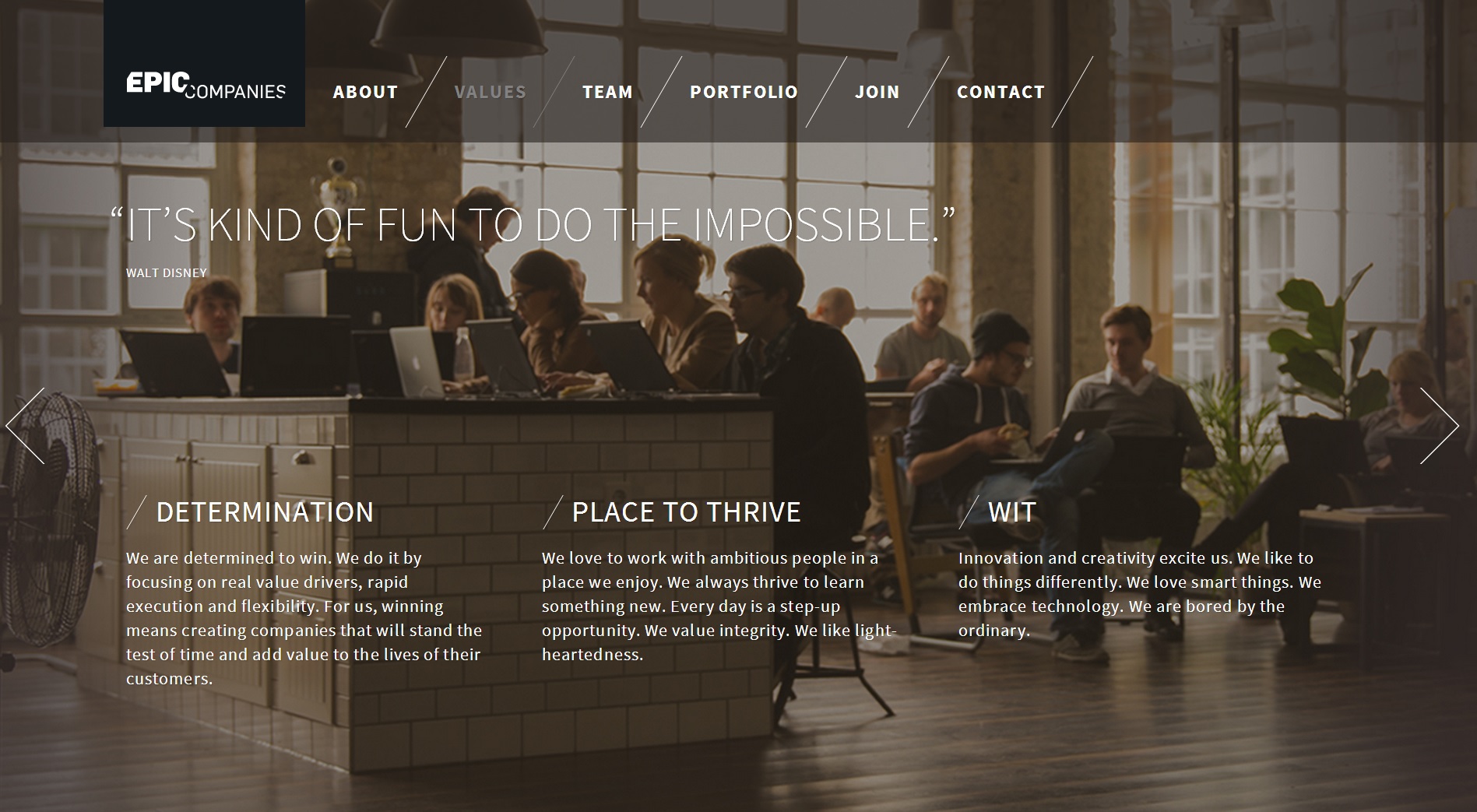
EPICs first year investments show a distinct and clear tendency towards the E-commerce segment. The incubator provides mainly early stage money, entrepreneur-expertise and media benefits through its parent company ProSiebenSat.1. Especially the media cooperation plays a decisive role for EPIC startups as they have the opportunity to advertise themselves through the TV-channels of the media group. The incubator sees the media presence especially for early stage startups as a crucial USP and a competitive advantage towards other startups. While the TV-presence is a useful tool that not many early stage startups can afford, it is no guarantee for success.
EPIC’s goal to launch four to five promising startups per year seems ambitious, yet feasible, given the companies expertise and management team around Mato Peric (former Rocket Internet). The Company, which settled in a hip building in Berlin-Kreuzberg’s Paul-Lincke-Ufer, formerly inhabited by German rapper Sido, is growing rapidly and meanwhile employs over 250 people (including portfolio companies). “The next three platforms are already in the works and will be launched in the next few weeks” announces Peric. It looks like EPIC is positioning itself for a bright future as one of the most recognized German company builders.
Picture: © EPIC companies

9 out of 10 startups fail. This simple rule is ubiquitous and is keeping many entrepreneurs from even trying their luck. Rehype.it is a new platform that aims to capitalize on that fact. The project, which started earlier this month, provides failed startups with a second chance. Participants can sell brands, domains or a complete businesses through the marketplace. The website sardonically states: “Your startup is insolvent – so what? With Rehype.it you can now turn every part of your project into cash.”
Tom Schneider, founder of Rehype explains the idea behind his startup: “Our concern is that, what has been created in many projects is not simply buried and thrown away, but that other people might be able to do something with it. People who may have better contacts or financial resources or an idea to take things a little differently.” He also points out that Rehype “is not just about failed start-ups, but also about projects that are already advanced, but cannot be continued for some reason.”
So if you are looking to get your hands on a few ideas (failed for whatever reason) or just want to be inspired by projects of other people, Rehype might be the place to check out. The market place grants its users an early bird special that includes free membership for the first 90 days after its inauguration. I’m already signed up. How about you?
Picture: © Rehype.it
 boldventureblog